Late weeknotes but trying to pick the habit back up.
One of the positives of the new work is that in some ways my weeknotes are almost superfluous. Because Ralph is writing his as well. But that’s a win of course, not a complaint.
Managing my health
Most of Wednesday and Thursday was spent exploring opportunities to help people manage their health better using the NHS App – what this really means is identifying where we can both:
- Improve how a task that someone currently completes in the app connects to another task (or new task) that they can do in the app.
- Improve the visibility of ‘preventative’ services within the app, to support people to use these services, before they actually get sick.
The main challenge here is the age old ‘mental model chicken and egg’ situation. Which I’ve just made a thing. But it basically goes something like this:
People currently use [insert product] in a very transactional way, because that’s all its ever offered. We can see evidence that people have other needs, because they’re meeting them using other tools and we think that by bringing them together it would have increased value. However – people don’t expect [product] to behave in this way, so can be surprised/confused by the change.
But Why?
It would be easy to say that this sounds like an org trying to ‘force’ the features it wants on people. And there is always a degree of that – especially when the Org is the NHS and it genuinely does want people to take more preventative measures regarding their health. But with my research hat on – its also an org saying ‘what do people actually need, and how can we fulfill those needs better’.
You could probably do the 5 why’s activity (AKA having any conversation with my 8 year old) and to show it. Lets smush it together with some kind of butchered user story.
As a person accessing healthcare in the UK…
- I want to be able to book an appointment to see my GP at a time that suits me
Why?
- Because I think I need medication for a recurring health condition that has flared up recently
Why?
- Because I want to feel healthier day to day and not rely on over the counter medication I’ve been using
Why?
- Because I want to be able to get back to work/looking after my grandchildren/enjoying my social life
Why?
- Because I want to live my fullest life for as long as possible and be there to support those that I love
etc – you get the idea.
Its fairly obvious that if we apply our research thinking to the needs that we see evidenced by users of the app, the need is there. People don’t actually want to book appointments with their GP, people want to be healthier for longer. An appointment with a healthcare professional is just one of the most tangible ways they can achieve this.
The big question is whether the NHS App is the right place for this. My instinct as it stands is that it will have to start there, because that’s where the eyeballs are.
Baby steps
How we do that is an interesting thing as well. Its tempting to paint a grand vision, as politicians and leaders are often required, or feel compelled to do. However I fell back on one of my fav diagrams. Baby steps will teach us the most, and build the most momentum as long as we take them intentionally.
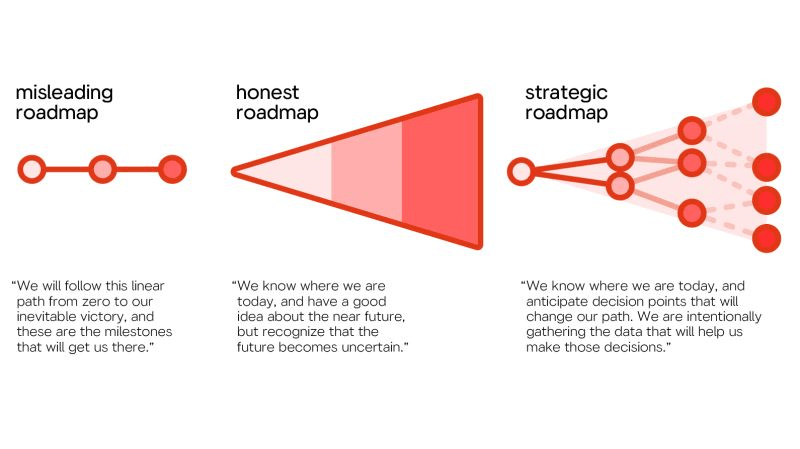
I also think its an appropriate response to the design challenge I mentioned above. How do you shift people’s expectations about how they interact with a product? Not by wholesale changes that assume a completely new relationship with the product. But with incremental, value creating changes that build on what already exists until the final ‘vision’ seems inevitable.
Internal Intent
Outside of NHS work, I’ve been chatting with a few colleagues about shoring up our approaches to design and research as we grow. The breadth and depth of experience across PD is amazing, but we’re probably not making the most of it and we could probably make it simpler for people when they join as perm or part of the network to hit the ground running.
That’s meant putting on my Research Ops and working through its relationship with e.g. ISO 27001 to make sure we are making it easy as possible for people to collect, store and delete data in the appropriate way. On the flip side its also meant digging into my ‘design research toolbox’ and reminding myself of the weird and wonderful approaches we used to take when virtually no research was a remote 1:1 interview.
I’ve definitely seen a huge shift during my career from wide ranging research methods, through to a lot of the same things done over and over and over again. In my head its a combo of:
- Covid – when we had to abandon all in person research, it makes it hard to retain the muscle & experience within teams.
- Shifting to digital – when I worked on physical devices, in person, in-home was essential. You can’t screenshare using a food processor.
- The growth of in house teams – Agency teams without internal pressure have the headspace for creative approaches, Solo researchers on internal teams don’t.
- The drive for ‘agile efficiency’ – global ethnographic studies don’t fit into neat 2 week sprint cycles.
Lets change this. Keep Design Research Weird. Might have found the next sticker.

Blue steel
Outside of work, weekends are mostly a blur of attempted lie ins, too many Minecraft videos, pancakes, kids parties, visiting friends, music etc.
This afternoon however, I picked up my first carbon steel cooking implement. You have to season it don’t you know. Currently working out how to make this my whole personality. What could possibly be better than a niche product that you can’t use for its intended purpose when you first buy it, that requires quite a lot of effort to ‘get right’ and you will almost certainly ‘get it wrong’, whilst making your house smell like a deep fat fryer in the process. Wonderful.

 alistairuff
Leave a comment