I’ve reflected a few times on the potential value of bridging the gap between academic and professional design research. Its worth being clear that this isn’t because I think is one is better/more high brow/more applicable than the other. I just like to have context and history of the development of design research theory and practice.
Maybe you do too? Maybe this isn’t for you, that’s also fine.
These are the things I’ve probably referred to the most in my career. For ease, I’m only linking to ones I’m aware of have an open access copy out there. Down with paywalls etc:
Co-creation and the New Landscapes of Design – Elizabeth Sanders & Pieter Jan Stappers – 2008.
This one really helped me get my head around the relationships between different design research approaches and critique the ‘usability-centric’ mentality of a lot of user research. I found its visualisation of the different methods especially helpful.
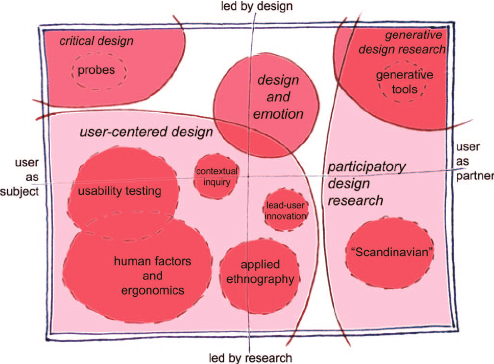
The authors also wrote ‘The convivial toolbox’ that covers similar topics in more detail.
Representing Future Situations of Service: Prototyping in Service Design – Johan Blomkvist – 2014
This is a whole PhD thesis so is long (92 pages in full), but was pretty much the most comprehensive piece of writing I could find at the point I was starting my own research.
Experience Prototyping – Jane Fulton Suri & Marion Buchenau – 2000
Hardly recent, and not necessarily the finest piece of academic work ever (probs beats mine though). This was the piece that made me understand that you can write up commercial design research projects (with all its constraints and compromises) as a contribution to research. Also Fulton Suri is one of the OG commercial design researchers – early days at IDEO etc.
Mostly in here, because it led to the ‘Service design tools‘ website, which is still a helpful reference that Tassi is still involved in (as far as I know0 and is kept up to date.
I refer a lot to their 2×2 matrix to talk about the different reasons that designers prototype, and how that should inform how we prototype. Its from automotive design, but principles apply in other sectors/types of design.
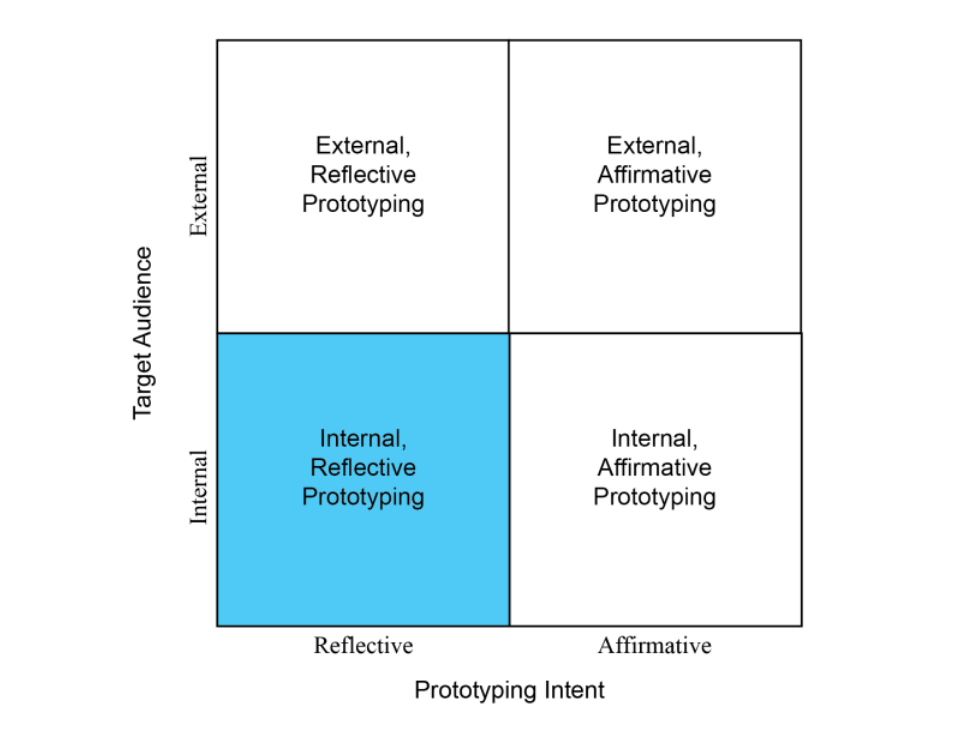
Amongst other things the authors define three prototyping principles that I find helpful:
- Fundamental prototyping principle: Prototyping is an activity with the purpose of creating a manifestation that, in its simplest form, filters the qualities in which designers are interested, without distorting the understanding of the whole.
- Economic principle of prototyping: The best prototype is one that, in the simplest and the most efficient way, makes the possibilities and limitations of a design idea visible and measurable.
- Anatomy of prototypes: Prototypes are filters that traverse a design space and are manifestations of design ideas that concretize and externalize conceptual idea
Evolving to a New Dominant Logic – Stephen L. Vargo & Robert Lusch – 2004
The original proposal of ‘service-dominant logic’ which suggests that instead of a distinction being needed between product and service marketing, it should all be service marketing. If you reconsider how value is being created & frame it as value in use, rather than the previous concept of embedding value in products that are then sold.
Bringing the worlds of service design and service-dominant logic together, a helpful framing of why service design can meet some of the initial gaps in new service development (who responded to S-D Logic). Found it helpful in speaking to other more marketing focused folk about the value of service design etc.

 alistairuff
Leave a comment